
Eleodor Sotropa
I was born in Romania, and I have spent much of my adult life in the United States. That sentence is geographically accurate, but emotionally incomplete. Like many people who leave one country and build a life in another, I have discovered that departure is not a clean administrative act. You can change continents, languages, habits, jobs, seasons, and grocery stores, and still find that some part of you remains where it began — near a family kitchen, a monastery road, a train station, a childhood apartment, or a conversation you did not know you were going to remember for the rest of your life.
That is the space I write from.
I live in Cincinnati with my family. By day, I work in technology, artificial intelligence, and enterprise transformation. By night — or more honestly, by weekend — I write. I write about Romania, memory, history, institutions, travel, business, food, family, and the small stubborn details by which a place continues to live in a person long after the person has left it.
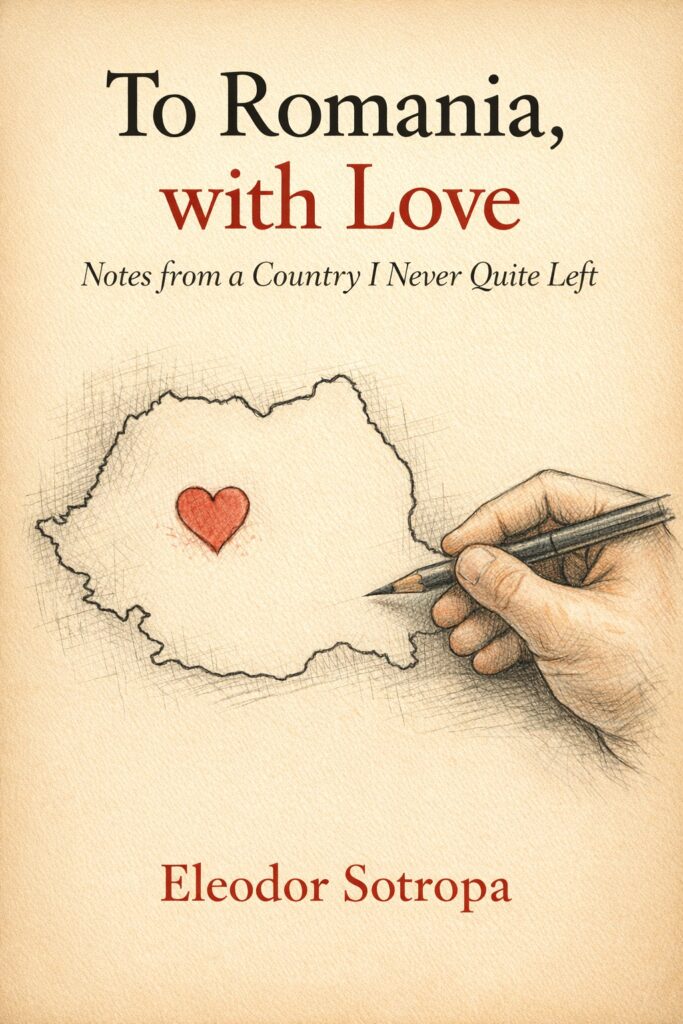
My first book, To Romania, with Love: Notes from a Country I Never Quite Left, came from that lifelong in-between. It is not a guidebook. It is not a ranking of destinations. It does not try to explain Romania in five convenient lessons, which is fortunate, because Romania would immediately object, ask who authorized the lessons, and then offer you soup. The book is made of notes — patient, wandering, attentive notes — about a country I left physically but never entirely left in any useful emotional sense.
I grew up in a family where history was not something that stayed obediently in books. My mother taught history, and from her I learned that the past is not really past if people are still living with its consequences, quoting its poets, cooking its food, arguing about its heroes, and driving past its buildings on the way to work. My sister taught me that travel is not escape; it is a way of sharpening attention. My family carried stories the way other families carry furniture: carefully, imperfectly, and with the occasional dispute about who remembers it correctly.
That inheritance shaped the way I see places. A monastery is never only a monastery. A city street is never only a street. A bakery is not just a place to buy something warm at seven in the morning. Every place has layers: historical, architectural, political, culinary, familial, and comic. The best ones usually disagree with each other.
I am interested in those disagreements.
I am drawn to countries that refuse to be summarized, to institutions that outlive their founders, to family stories that survive several regimes and still arrive at the table slightly exaggerated, and to objects or habits that quietly explain more than official speeches do. I like the place where a public history and a private memory accidentally meet: a church wall, a wooden gate, a bowl of soup, a business that changed the rhythm of a city, a line from a poet, a train ride, a family photograph, a phrase someone says at lunch that turns out to be an entire worldview.
Professionally, I have spent my career in technology and large organizations, working on digital transformation, AI, automation, data, enterprise systems, and the future of work. That world may seem far from literary travel writing, but to me the two are closer than they look. Both are about making complicated things legible. In one case, the question is how work actually happens inside a modern enterprise. In the other, the question is how a country actually lives beneath its postcards, slogans, and official photographs.
I have spent many years helping organizations adopt new technologies, build new capabilities, and rethink how work gets done. I have watched tools arrive as curiosities and become infrastructure. I have seen how much of transformation depends not on the technology itself but on whether people can describe what they do clearly enough to improve it. Clarity, in that sense, is not a stylistic preference. It is a form of progress.
That belief carries into my writing. I do not trust grand explanations very much. I prefer observation. I prefer the precise detail. I prefer the sentence that admits what it does not know. I prefer the kind of attention that slows down long enough to notice the ordinary thing doing extraordinary work.
To Romania, with Love grew slowly. It began as memory, became notes, turned into drafts, and eventually became a book after years of returning, revising, questioning, cutting, restoring, and occasionally wondering whether the whole project was less a manuscript and more a hereditary condition. I come from a family where writing, reading, and arguing with history were treated less as hobbies than as long-running civic obligations.
The book is my way of continuing that conversation.
Romania, for me, is not an abstraction. It is Bucovina and Bucharest, monasteries and apartment blocks, soup and irony, painted walls and business stories, family memory and public history, the country before 1989 and the country after, the one I knew as a child and the one I keep meeting again as an adult. It is older, quieter, stranger, funnier, more wounded, more inventive, and more durable than the postcards suggest.
I return often. Each return corrects something. Each return also complicates something. That is one reason I keep writing. A country you love should not be made simpler for the convenience of a paragraph. It should be allowed to remain alive on the page – contradictory, affectionate, difficult, funny, unresolved.
The same is true of identity. I am Romanian and American. I am an IT engineer by training and a writer by temperament. I work in AI and write about memory. I spend my days thinking about the future of work and my weekends thinking about monasteries, cities, food, institutions, and the emotional logistics of belonging to more than one place. None of these are contradictions exactly. They are simply the arrangement life handed me, and I have learned to take notes.
I write because I do not want the small things to disappear unnoticed. The family sentence. The old photograph. The smell of bread near a tram stop. The sound of Romanian spoken quickly by people who love each other enough to interrupt. The way a country can survive in gestures, recipes, jokes, prayers, businesses, buildings, and habits. The way leaving can become another form of attention.
I also write because I believe the best stories do not explain us away. They return us to ourselves with better questions.
If there is a thread through my work, it is probably this: I am interested in what people carry. Countries carry history. Families carry memory. Organizations carry habits. Technologies carry assumptions. Individuals carry all of it, usually while pretending to travel light.
I have never traveled light.
I carry Romania. I carry Cincinnati. I carry family stories, professional lessons, old books, unfinished drafts, airport notes, too many ideas, and a persistent belief that attention is one of the few forms of love that improves with practice.
This site is where some of that carrying becomes visible. It is where I write about books, memory, Romania, travel, technology, institutions, AI, work, and the places where these subjects unexpectedly meet.
Welcome. I am glad you are here.
Stay a while. The country prefers it that way.
All opinions expressed here are my own. Passionate about AI, Consumer Insights, SaaS, Travel, Marketplaces and startups.
Connect with me in LinkedIn, or follow me on Twitter.